

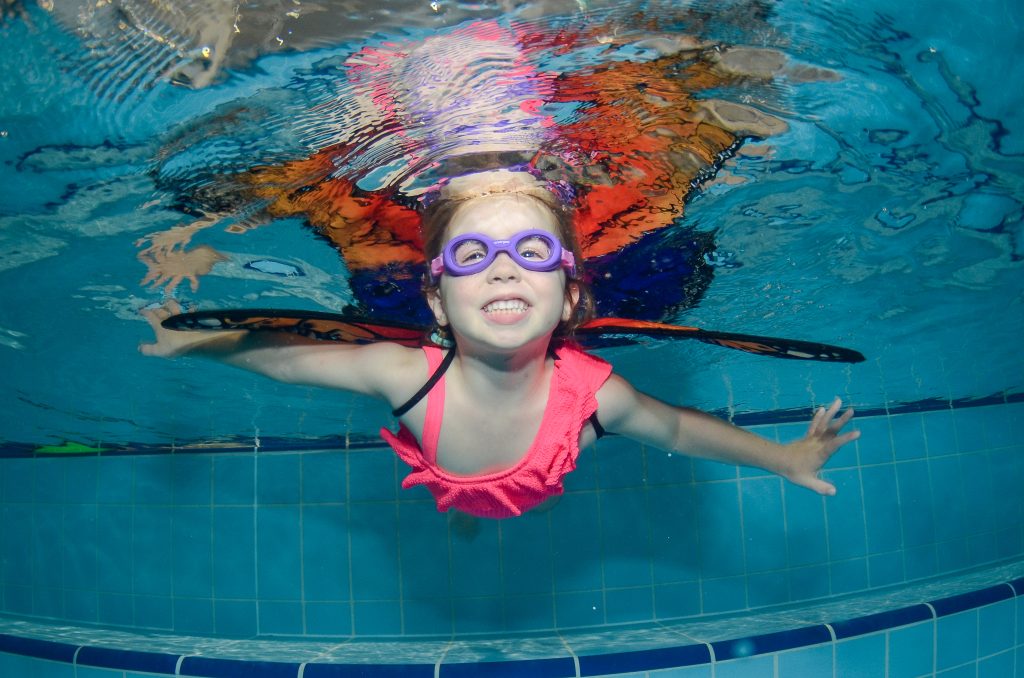
What Age Should Kids Start Swimming Lessons?
Most children can start swimming lessons from as young as 3 months old, though the age that matters most depends on what you're aiming for. If you want early water confidence and safety conditioning, paediatric and swim safety bodies support starting in infancy with a parent in the water. At Neptune, we start teaching the building blocks of self-rescue from as early as 3 months old — there's no getting around it: the more water safety exposure your child has, and the earlier it starts, the sooner they can swim independently.
There's no single "correct" age that applies to every family — but there is a clear, research-backed window for starting, and a clear progression for getting to independent swimming. Here's what the evidence says, stage by stage.
Quick answer: Babies can start parent-and-bub water safety lessons from 3 months — Neptune offers this free for babies aged 3 to 6 months. With consistent lessons, children can begin swimming independently from around age 3, which is when Neptune's Jellyfish class moves kids into the water without a parent. Without structured lessons, the general population average for independent swimming sits closer to 4–6 years. The single biggest factor isn't age at all: it's consistency of lessons over time.
What the Research Says About the Best Age to Start Swimming Lessons
The American Academy of Pediatrics (AAP) recommends swim lessons as one layer of protection against drowning that can begin for many children from age 1, provided the child shows developmental readiness. By age 4, the AAP notes most children are ready to learn real water survival skills such as treading water and reaching an exit point. Importantly, the AAP is also clear that there's no evidence formal infant swim programs for babies under 12 months reduce drowning risk — but parent-child water play classes at this age are considered a safe, beneficial way to build comfort and positive associations with water.
That distinction matters. A 3 to 12-month-old in the pool isn't being taught to "swim" in the traditional sense — they're building water familiarity, breath control responses, and the instinct to reach for a wall, all with a parent beside them. This is exactly the model behind Neptune's own baby program (more on that below).
On the safety side, the case for starting early is strong. A widely cited case-control study in The Journal of Pediatrics found formal swimming lessons were associated with an 88% reduction in drowning risk for children aged 1–4 (though the researchers note a wide confidence interval, given the study's sample size). The direction of the finding has held up across the broader body of research since.
In Australia, the stakes are high. Royal Life Saving Australia's National Drowning Report 2025 recorded 357 drowning deaths in the previous 12 months — 27% above the 10-year average. Separately, Royal Life Saving's research into school-aged children found a concerning decline in swimming competency: teachers estimate roughly half of Year 6 students can't swim 50 metres and tread water for two minutes, the national benchmark for that age group — a gap that tends to widen without consistent lessons through primary school.
The takeaway isn't "start at exactly age X." It's that early, structured, and — critically — consistent lessons through the toddler and primary school years build the safety skills that matter, and starting earlier gives you a longer runway to get there.
Stage-by-Stage: What to Expect at Each Age
Babies (3–36 months)
A parent or carer stays in the water for every lesson right through this whole stage — there's no early hand-off. What changes is the skill level. In Coral (3–12 months), it's all comfort, trust and safety conditioning: cue words, wall-holding, and supported floats. In Kelp (12–24 months), toddlers build real physical skills — kickboard work, streamline jumps, independent floats — while still working alongside a parent. By Starfish (24–36 months), children are entering the water independently, completing structured float sequences, and following instructor direction with minimal parent involvement, deliberately preparing them for the next step: Jellyfish, where children swim without a parent in the water for the first time, in a small class of just three students. That transition, usually around age 3, is where independent swimming really begins.
Independent swimmers & school-age (3+ years)
From Jellyfish onwards, children build real stroke technique and swim independently for increasing distances. This is also where Royal Life Saving Australia's national benchmarks apply — 50 metres plus 2 minutes of treading water by age 12, scaling up to 400 metres and 5 minutes by age 17. Consistency through primary school matters as much as the starting age.
Signs Your Child Is Ready for Independent Swimming
Parents often ask what age can a child swim independently — but readiness is a better predictor than age alone. Look for:
- Confident, unassisted floating — front and back, for 10–20 seconds without help.
- Coordinated kicking and arm movement that propels them forward, even if the stroke isn't textbook-perfect yet.
- Independent entry and exit — climbing in and out of the pool without being lifted.
- Comfort with submersion — going underwater and resurfacing without panic.
- Following instructor directions without a parent needing to translate or reassure them in the water.
- Knowing what to do when tired — reaching for the wall or edge to rest rather than continuing to struggle.
Most children reach this combination of skills somewhere between 4 and 6 years old, though it depends heavily on how early and how consistently they started lessons.
What to Look for in a Swim School at Each Age
What to prioritise shifts as your child grows:
- For babies and toddlers: look for warm water (around 32°C), small class sizes, a program that requires a parent in the water, and a genuine safety curriculum — cue words, wall-holding, and safe entry, not just play.
- For preschoolers: look for a clear, structured progression with defined skill checkpoints, so you can see your child advancing rather than repeating the same level indefinitely.
- For school-age children: look for instructors tracking progress against recognised benchmarks (like Royal Life Saving's national standards), and a program that keeps building stroke technique and endurance rather than plateauing once a child can "swim."
- At every age: qualified, currently certified instructors, lifeguards with current CPR/first aid certification, and the ability to watch a class before enrolling.
Neptune's Baby Programs: Coral, Kelp & Starfish Explained
At Neptune, babies start from 3 months old in our heated 32°C pool, with a parent in the water for every lesson. The program is built as three progressive levels, so families always know exactly what their child is working toward next.
Free Baby Lessons (3–6 months): Neptune offers free swimming lessons for babies aged 3 to 6 months at Eastern Creek — the easiest way to try the program before committing. Register for a free baby class →
- Coral (3–12 months): your baby's first experience in the water. The focus is comfort, trust, and the very first safety instincts — cue word conditioning, kicking, wall-holding, and supported back floats.
- Kelp (12–24 months): growing independence. Toddlers begin transitioning from parent to instructor, start using a kickboard, and build toward jumping in and returning to the wall on their own.
- Starfish (24–36 months): real, structured skill-building. Children enter the water independently, complete the signature Starfish float sequence (front float → roll to back → count to 10 → roll forward → swim to wall), and build toward the biggest milestone yet — the transition into Jellyfish, where children swim without a parent in the water for the first time, in a small class of just three students.
After Starfish, children move into Jellyfish and Neptune's structured Learn to Swim pathway, where the independent swimming and safety benchmarks described above come into focus.
Frequently Asked Questions
When can you start swimming lessons?
From as young as 3 months, in a parent-and-baby format focused on water comfort and safety conditioning rather than swim strokes. Formal, more independent instruction typically starts from around age 3.
What is the best age to start swimming lessons?
There isn't one perfect age — starting in infancy (with a parent in the water) builds comfort and safety instincts early, while the biggest jump in independent swimming ability usually happens between ages 3 and 6 with consistent lessons. The best age is the one your family can commit to attending consistently.
What age can a child swim independently?
With consistent, structured lessons, children can begin swimming independently from around age 3 — that's when Neptune's Jellyfish class moves kids into small, parent-free classes of three. Without early, consistent lessons, the general population average sits closer to 4–6 years old.
Is there a best age to start swimming lessons in Australia specifically?
Australian guidance broadly mirrors international recommendations: early water familiarisation from infancy is safe and beneficial with a parent in the water, and Royal Life Saving Australia's national benchmarks expect children to reach defined swimming and water safety milestones by ages 6, 12 and 17 — which means consistent lessons through primary school are essential, not optional.
Do I need to get in the water with my baby?
Yes, for babies and young toddlers. A parent or carer in the water is standard practice for infant and toddler swim programs, including Neptune's Coral and Kelp levels, and is considered best practice for safety and bonding at this age.
What if my child is older and hasn't started lessons yet?
Start now. While earlier is generally better, children of any age benefit from structured lessons, and Royal Life Saving's research shows the real risk is falling behind on national swimming benchmarks — not the age lessons began.
Book a Free Trial Lesson
Whether your baby is ready for their very first splash or your child is working toward independent swimming, Neptune's programs are structured to take them there — one level at a time, in a warm, safe, indoor pool.